How to Get Rid of Ants in the House
Learn how to get rid of ants in the house for good: why sprays alone fail, the trail-and-nest method that works, and when to call a licensed technician.
Key takeaways
- Wiping away an ant trail with detergent only removes the scent marker, not the colony, so ants reroute within hours
- Slow-acting gel bait carried back to the nest is far more effective than surface sprays for coastal and pavement ants common in Adelaide
- Adelaide's clay-heavy soils push ant colonies toward house slabs and paving in summer, which is why trails often appear along skirting boards after a hot spell
- Persistent trails, multiple nest sites, or ants returning after DIY treatment usually mean it is time to bring in a licensed technician
The fastest way to get rid of ants in the house is to stop treating the trail and start treating the colony: use a slow-acting gel bait that worker ants carry back to the nest, remove the food and moisture drawing them in, and seal the entry points they are using, rather than wiping them away with spray.
Why spraying ants rarely works
Most Adelaide homeowners reach for a can of surface spray the moment a trail appears along the kitchen skirting board. It feels productive: the ants you can see die within seconds. The problem is what you cannot see. A mature ant colony can hold thousands of workers and one or more queens, all sitting safely underground or inside a wall cavity, completely untouched by whatever you sprayed on the tiles.
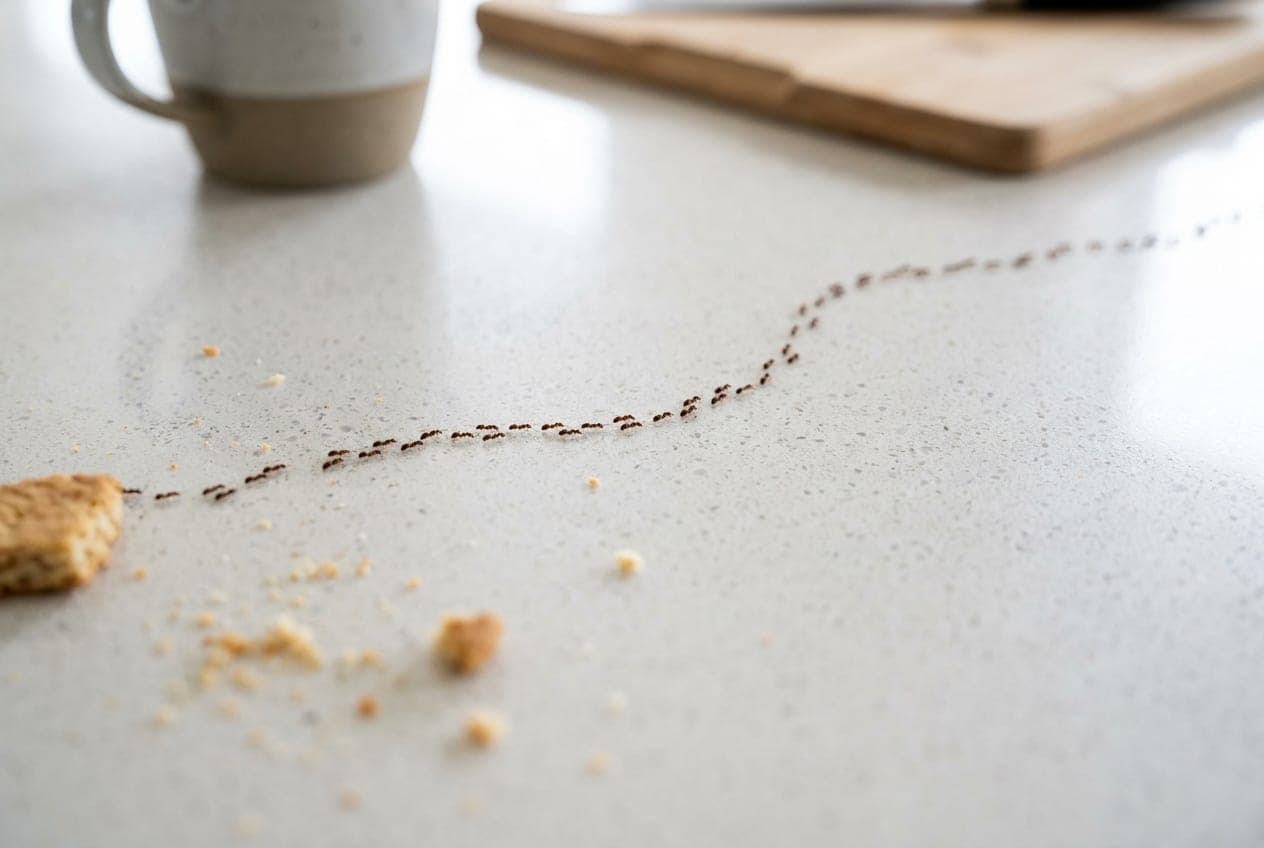
Worse, wiping the trail with cleaning spray or detergent removes the pheromone scent the ants were following, which briefly looks like a win. In reality, the colony simply sends out scout ants, finds a new route to the same food source within a day or two, and lays a fresh trail. This cycle, spray, wipe, reappear, is the single biggest reason ant problems drag on for months in Adelaide homes rather than resolving in a week.
The trail-and-nest method that actually works
The technicians we connect Adelaide homeowners with generally work from a simple principle: let the ants do the work of destroying their own colony. Rather than an insecticide that kills on contact, slow-acting bait is formulated to let worker ants carry it back to the nest, where it spreads through grooming and feeding to the queen and larvae. It takes longer, often 1 to 2 weeks for a full result, but it deals with the source instead of the symptom.
For homeowners wanting to understand which approach suits their situation, from a single kitchen trail to a recurring problem across multiple rooms, the pest treatment quote calculator is a useful starting point before booking an inspection.
What to do while bait is working
- Do not spray or wipe away the trail once bait is placed. Ants need to keep walking the same path to carry bait back to the nest.
- Remove competing food sources: seal the pantry, wipe up spills promptly, and keep pet food bowls from sitting out overnight.
- Fix obvious moisture issues near the trail, since many common household ants are drawn to damp timber or leaking taps as much as food.
- Expect activity to increase briefly before it drops off. This is often a sign the bait is being carried into the colony, not a sign it has failed.
Why Adelaide's soil and climate make ants persistent
Here is the detail most generic pest advice misses: Adelaide's clay-heavy soils in suburbs across the plains hold heat and moisture differently to sandier coastal ground, and that changes ant behaviour season to season. Through a hot, dry summer, the clay bakes hard and cracks, pushing many ground-nesting colonies toward the cooler, moisture-retentive ground under house slabs, paving and garden edging. That is exactly why so many Adelaide households see a trail suddenly appear along an internal skirting board in late spring or over summer, seemingly from nowhere. The ants have not travelled far. They have simply relocated from cracked garden soil to the cooler ground right under the house.
This is also why treating only the visible trail inside misses the point entirely. If the colony has shifted to sit under the slab, effective treatment needs to account for the exterior perimeter as much as the kitchen bench.
Common ants in Adelaide homes
Coastal brown ants and small black pavement ants are the two species most often reported inside Adelaide kitchens and bathrooms, typically drawn in by sugary spills, pet food or crumbs. Bull ants and jack jumpers are more likely encountered in the garden or under paving rather than indoors, but their bite can cause a significant reaction in some people, so nests near entertaining areas or children's play spaces are worth having assessed. If ants are turning up alongside other pest activity, such as cockroaches drawn to the same food sources, it is worth reading how to get rid of cockroaches in Adelaide as the underlying causes often overlap.
When to call a licensed technician
DIY bait works well for a single, contained trail. It is time to bring in help when:
- Ants keep returning to the same area after 2 to 3 weeks of consistent baiting
- You are finding multiple separate trails in different rooms, suggesting more than one colony or entry point
- The nest appears to be inside a wall cavity or under the slab, where DIY bait placement cannot reach it effectively
- You want a pet-safe or child-safe treatment plan, particularly in homes with young children or pets that explore skirting boards and garden beds
In these cases, we connect you with licensed Adelaide technicians who can identify the species, locate the nest (or confirm it is out of reach) and apply a targeted treatment plan rather than a generic spray-everywhere approach. For homeowners who prefer options that avoid heavier chemical use around kids and pets, it is worth asking about eco-friendly and pet-safe options at the time of booking.
Ants are also one of the most common issues Adelaide households deal with alongside broader seasonal pest pressure, which is covered in more depth in the general pest treatment guide for Adelaide.
A quick before-you-call checklist
Before booking a technician, it helps to have a few details ready: how long the trail has been active, roughly how many separate trails or rooms are affected, whether you have already tried spray or bait, and whether pets or small children use the affected areas. According to CSIRO's information on ant biology and control, ant colonies can persist for years once established, which is exactly why a considered approach beats a quick spray every time.
Getting rid of ants for good in an Adelaide home comes down to patience with the right method rather than speed with the wrong one. Bait the trail, protect it while it works, address the moisture and food sources drawing ants in, and call in a licensed technician if the colony proves larger than a single trail suggests.
Ready to get quotes from licensed technicians?
Tell us about your problem and we match you with a vetted local operator. Free, no obligation.
Get free quotesFrequently asked questions
Surface sprays kill the ants you can see but rarely reach the nest, and the queen keeps producing workers. Wiping the visible trail also removes the pheromone scent, so the colony sends scout ants to find a new path within a day or two, which is why the problem looks like it never left.
Cleaning surfaces with vinegar or soapy water breaks the scent trail temporarily, and sealing entry points helps, but neither of these deals with the nest itself. For a lasting result, slow-acting bait that worker ants carry back to the colony is the more reliable approach, alongside removing food sources and moisture.
Most ants found inside Adelaide homes, such as coastal brown ants and pavement ants, are a nuisance rather than a health risk. Some species can contaminate food or, in the case of bull ants, deliver a painful bite, so persistent activity is still worth addressing properly.
General ant treatment for a typical Adelaide home usually falls in a similar range to other general pest jobs, though the exact price depends on colony size, accessibility and how many entry points need treating. A licensed technician can give an accurate figure after inspecting the property.