Chemical Soil Barrier Treatment: What to Expect
What happens during termite barrier treatment in Adelaide: the process, timing, disruption, and how a chemical soil barrier actually stops termites.
Key takeaways
- A chemical soil barrier creates a continuous treated zone around and under the home that termites cannot cross undetected, rather than killing a visible nest.
- Modern non-repellent termiticides are transferred between termites through contact, so the colony is affected even where the barrier itself is never touched.
- Installation usually takes 1 full day for an average Adelaide home, with trenching, drilling and sub-slab injection depending on construction type.
- Barriers typically carry a 8-year manufacturer warranty against reinfestation, but they only work if the treated zone stays unbroken, which is where most DIY and budget jobs fail.
Chemical soil barrier treatment creates a continuous zone of treated soil around and beneath a house, using a non-repellent termiticide that termites cannot detect and carry back to the colony. It does not just block entry: it is designed to affect the nest itself over several weeks, without the homeowner ever seeing a termite.
That distinction matters more than most homeowners realise. Adelaide has a lot of housing stock from the 1960s to 1980s with brick veneer over a shallow footing, and a barrier installed on one of these homes behaves differently to one installed on a modern slab-on-ground build in Mawson Lakes or Blakeview. The soil profile, the number of penetrations (pipes, weep holes, expansion joints), and the perimeter length all change how the job is actually done, even though the end result on paper looks the same.
How the barrier actually works
A repellent barrier (older-style, less common now) simply deters termites from crossing. A non-repellent barrier, which is what most licensed Adelaide technicians install today, does the opposite: it is undetectable to termites. They tunnel straight through it, absorb the active ingredient on contact, and return to the colony still alive long enough to transfer it to nest mates through normal grooming and trophallaxis (mutual feeding). It is a slow, colony-wide effect rather than an instant kill at the boundary.
This is why a correctly installed barrier can eliminate an active infestation, not just prevent a new one. If you are still working out whether a barrier or a bait system suits the situation, Termite Baiting Systems Explained: Do They Work? covers the alternative approach, and it is worth reading both before deciding, since the right call depends on the extent of activity already found and the construction type.
What a typical Adelaide install day looks like
For a standard 3 to 4 bedroom home, barrier installation usually takes a full day. The exact sequence depends on the site, but generally includes:
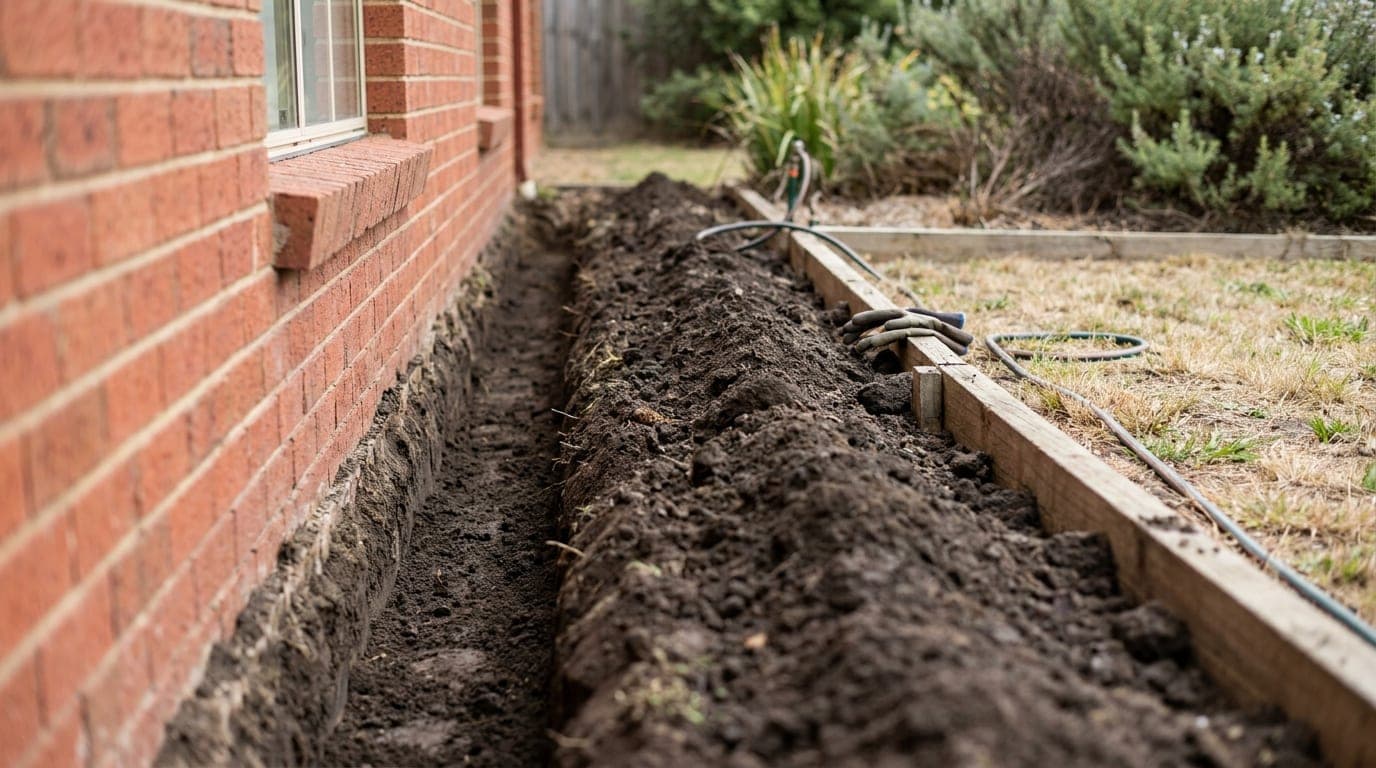
- Trenching along accessible garden beds and pathways next to the foundation, so the termiticide can be applied directly into the soil profile.
- Drilling through paving, concrete slabs and paths at set intervals, since those hard surfaces have to be penetrated to treat the soil underneath them, not just the exposed dirt.
- Sub-slab injection for homes on a concrete slab, pumping treated solution beneath the slab through the drilled holes.
- Treating around penetrations, meaning pipes, conduits, and any point where plumbing or services pass through the slab or foundation wall, because these are common termite entry points that a simple perimeter trench would miss.
- Patching, where drill holes are filled to match the surrounding surface as closely as practical.
For a full walk-through of what happens on the day itself, including what the technician checks before and after, see What Happens During a Termite Treatment (Step by Step).
The local mistake worth naming directly
The most common failure Adelaide homeowners run into is not a bad product, it is a broken barrier. A continuous chemical zone only works while it stays continuous. Retic and irrigation trenching dug after the job, a new garden bed built up against the foundation, a deck added without notifying the pest technician, or a driveway re-poured over an untreated section: any of these can open a gap termites will eventually find. On the older bungalow-style homes common through the western and southern suburbs, where owners often do their own landscaping over a weekend rather than calling a professional, this is the single biggest reason a supposedly "treated" home gets termites again 3 or 4 years later. A barrier is not a one-off purchase, it is a boundary that needs to be respected every time a shovel goes into the ground near the house.
What it costs and what affects the price
Price depends on perimeter length, number of penetrations, soil type, and access difficulty (a home backing onto a shared driveway or a tight courtyard costs more to trench than a standard suburban block). Rather than guessing, use the termite treatment cost estimator to get a realistic range for the home's footprint before booking an inspection.
It is also worth being sceptical of a barrier quote that comes in well below the local range. A shortcut on drilling density or termiticide dosage is invisible on the invoice and invisible for the first year or two, but it shows up eventually as a gap in the treated zone. The Australian Government's guidance through the Department of Agriculture, Fisheries and Forestry on termiticide registration exists precisely because dosage and application method are what make a barrier effective, not just the brand of chemical used.
Warranty and what it actually covers
Most chemical barrier treatments in South Australia come with a warranty period, commonly around 8 years, tied to the specific termiticide product used and the conditions under which it was installed. That warranty is not automatic protection against every future issue. It typically requires:
- An annual termite inspection to keep the warranty valid.
- No unauthorised disturbance of the treated zone (the retic and landscaping issue above).
- Notification if renovations, extensions or new paving are planned near the barrier line.
Standards Australia's AS 3660 series is the reference framework licensed technicians work to for termite management and barrier systems, and it is worth asking whoever quotes the job to confirm the treatment will be installed and documented to that standard.
Getting matched with the right technician for the job
Not every property is a straightforward trench-and-drill job. Sloping blocks, homes with limited crawl space, and older stone cottages around the CBD fringe all need a technician who has actually handled that construction type before, not just a general pest operator ticking a box. When you enquire through termite treatment, the licensed technician we match you with will assess the specific footing, soil, and access constraints of the home before quoting, rather than pricing a generic barrier off a phone conversation.
The bottom line
A chemical soil barrier is a well-understood, well-tested method: continuous treated soil, a non-repellent termiticide that reaches the colony through natural termite behaviour, and a warranty that rewards ongoing vigilance rather than a set-and-forget mindset. The technology is not the risk. The risk is what happens to the barrier after the trucks leave, particularly around landscaping and renovations. Get the install done properly, keep the annual inspection up, and treat the treated zone as a permanent feature of the property, not a one-time event to forget about.
Ready to get quotes from licensed technicians?
Tell us about your problem and we match you with a vetted local operator. Free, no obligation.
Get free quotesFrequently asked questions
Most modern termiticides used in Adelaide are rated for around 8 years of soil-borne protection, backed by a manufacturer warranty. The technician we match you with will confirm the exact product and warranty term for the home, since ground disturbance, gardening and renovations can shorten the effective life.
Non-repellent termiticides are designed to do exactly that. Termites cannot detect the treated zone, so they walk through it, pick up the active ingredient, and carry it back to the nest where it transfers to other termites through grooming and feeding. A well-installed barrier is a colony-level control, not just a wall the termites cannot cross.
There is minor, localised disturbance: a trench along garden beds, small drill holes through paving or concrete that are patched afterward, and possibly some soil removed near the foundation. It is not comparable to construction work, and the licensed technician we match you with will walk through exactly what to expect for the home's layout before starting.
Yes. Homeowners are typically able to remain on site, though pets are usually kept away from treated areas until they dry, generally a few hours. The technician will confirm safe re-entry timing for children and pets based on the specific product used.