How Long Does Termite Treatment Take to Work?
How long does termite treatment take to work in Adelaide homes: setup timing, colony die-off windows, and when technicians recheck for activity.
Key takeaways
- Chemical soil barrier treatment is applied in a single day, but full protection only becomes reliable once the treated zone is complete and undisturbed, usually within 24 to 48 hours.
- Baiting systems are slower by design: expect 3 to 6 months of monitoring before a colony is confirmed eliminated, because bait relies on termites feeding and sharing it.
- Visible activity (mud tubes, live termites) can stop within 1 to 2 weeks of a barrier treatment, but stopped activity is not the same as a fully treated colony.
- Older Adelaide homes on stumps or with additions built over multiple decades often need a longer inspection window because termites can be active in one zone and undetected in another.
- A licensed technician will schedule a follow-up inspection, usually at 3 and 12 months, to confirm the treatment has held rather than just assuming it worked.
Chemical soil barrier treatment is physically applied in a single day for most Adelaide homes, but the colony-level effect takes longer: expect 1 to 2 weeks before visible activity stops, and a full 3 to 12 months before a licensed technician confirms the colony is gone. Baiting systems run on a slower, monitoring-based timeline of 3 to 6 months or more. The method you choose changes the clock more than anything else.
This is the part homeowners get wrong most often. They watch the technician finish drilling and trenching, see the invoice, and assume the job is "done" in the way a plumbing repair is done. Termite treatment isn't a single event. It's a process with a start date and a confirmation date, and the gap between them is where most of the anxious phone calls happen.
Why "how long" depends on the method, not just the house
There are 2 broad approaches used across Adelaide, and they behave completely differently on a timeline.
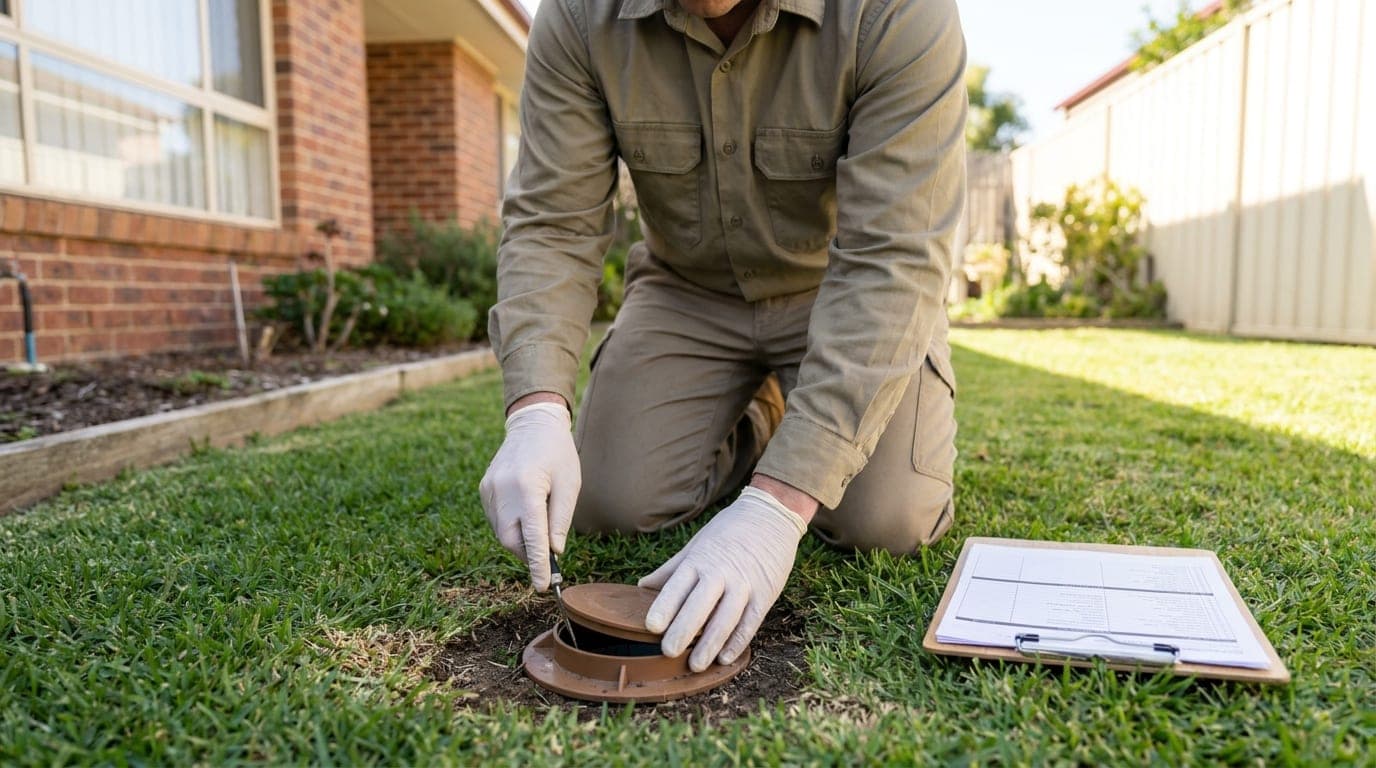
Chemical soil barriers create a continuous treated zone in the soil around and under the structure. Termites pick up the non-repellent chemical as they pass through it and carry it back to the colony, where it transfers to other workers, the queen, and the brood. The application takes a day, sometimes 2 for larger or more complex footprints. The die-off inside the colony plays out over the following weeks. You can read more about how termite treatment works if you want the mechanism explained in full, and the chemical soil barrier treatment breakdown covers what the application day itself looks like.
Baiting systems are the slow-and-steady option. Stations go into the ground around the property, termites find and feed on the bait, and the active ingredient (usually a chitin synthesis inhibitor) spreads through the colony as workers share food with each other. This is deliberate and effective, but it is not fast. Monitoring visits every 4 to 8 weeks are standard, and a full elimination timeline of 3 to 6 months is realistic, sometimes longer for a large or well-established colony.
Neither is "better" in the abstract. The right call depends on the property, the level of confirmed activity, and whether you're treating an active infestation or building in long-term protection. The licensed technician we match you with will walk you through which timeline fits your situation, and the termite treatment method selector is a useful starting point if you want to think it through before that conversation.
The Adelaide factor most guides skip: subfloor access and build era
Here's something that doesn't show up in generic pest-control content: how long treatment takes in Adelaide is heavily influenced by when and how the home was built, not just its size.
A huge share of Adelaide's housing stock, particularly in the middle-ring suburbs and older parts of the Adelaide Hills, was built between the 1950s and 1980s on brick-and-stump or partial-stump foundations, often with later additions bolted on at the back. Each addition can have its own slab edge, its own subfloor void, and its own gap in the original barrier. A technician treating one of these homes isn't just running a trench around a rectangle. They're mapping 3 or 4 separate construction zones and treating each junction where an addition meets the original build, because that's exactly where barriers fail first.
This is why a straightforward 1990s slab-on-ground home in a newer suburb can be fully treated in a single visit, while a character home in Unley or Burnside with a rear extension can take a second visit just to finish the subfloor sections properly. It's not the pest technician padding the job. It's the reality of treating a structure that was never built as one continuous slab in the first place. If your home fits this pattern, it's worth reading what happens during a termite treatment so you know what the extra time is actually being spent on.
What happens week by week after a barrier treatment
- Day 1 to 2: application is completed, treated zones are left undisturbed, and the technician advises which areas (freshly trenched soil, drilled slab points) need to be left alone.
- Week 1 to 2: termites moving through the treated zone begin transferring the chemical through the colony; visible activity such as mud tubes often starts drying out or stops appearing.
- Week 3 to 12: the bulk of the colony die-off occurs; this is the window where "it looks fine now" needs to hold up.
- 3 months: the first formal follow-up inspection is typical, checking for any renewed activity at the perimeter or at untreated gaps.
- 12 months: a full annual check confirms the barrier is holding and looks for any new entry points, which matters because termite barriers do have a working life and aren't a one-off, permanent fix.
Why "it looks like it's working" isn't the same as "it's done"
This is the single most common source of premature relief. A homeowner sees mud tubes dry up after a week and assumes the problem is solved. Sometimes it is. Sometimes it means the termites have simply relocated to an untreated section of the same structure, especially in one of those multi-era Adelaide homes described above. The only way to actually know is a scheduled recheck, not a visual scan from the backyard.
If you're not sure whether what you're seeing counts as progress or a red flag, signs your termite treatment is working sets out what to expect at each stage and when a call-back is genuinely warranted versus when you're just watching the normal timeline play out.
Warranty timelines mirror the treatment timeline
Most treatment warranties in South Australia run for a fixed term (commonly 5 years for a chemical barrier, shorter for baiting depending on the product), and that clock typically starts from the completion of the treatment, not from when activity visibly stopped. Understanding this distinction matters if you ever need to make a claim. The termite treatment warranty in South Australia page covers exactly what's covered and for how long, which is worth reading alongside this one since the warranty period and the "how long does it take to work" period are 2 different clocks running side by side.
For broader guidance on termite biology and why colony elimination is inherently a multi-week to multi-month process rather than an instant fix, the CSIRO's pest and urban entomology research is a useful independent reference point, as is Standards Australia's AS 3660 series, which governs termite management systems used in Australian construction.
The bottom line on timing
Application is fast. Confirmation is not, and it shouldn't be. A technician who tells you "give it a year to be fully sure" isn't being evasive, they're describing how termite biology actually works. If you're dealing with a live infestation or want a timeline specific to your property's age, layout, and construction history, connecting with a licensed local technician through termite treatment gets you a schedule built around your actual home rather than a generic estimate.
Ready to get quotes from licensed technicians?
Tell us about your problem and we match you with a vetted local operator. Free, no obligation.
Get free quotesFrequently asked questions
No. With a chemical barrier, termites do not die on contact; they pick up the treatment and spread it through the colony over days to weeks, which is what eventually collapses the nest. With baiting, die-off is slower again, often taking months, because the whole point is colony-wide transfer rather than a fast kill.
Visible signs like mud tubes drying out or live termites disappearing can show within 1 to 2 weeks for a barrier treatment. A proper confirmation, though, comes from the follow-up inspection the licensed technician books in, not from what you can see with the naked eye.
The application itself is often quicker on a slab because there is direct soil access around the perimeter. Stumped homes and homes with under-house additions usually need extra time for the technician to check subfloor voids, which is common in Adelaide's older housing stock.
Not meaningfully, and trying to rush it usually backfires. Disturbing the soil, digging near the barrier, or moving stored items back under the house before the technician clears the area can undo days of work and reset the timeline.