How Termite Treatment Works: Chemical Barriers, Baiting and Dusting Explained
How does termite treatment work? A clear breakdown of chemical barriers, baiting systems and dusting, and which one suits your Adelaide home.
Key takeaways
- Termite treatment works one of 3 ways: a chemical soil barrier that blocks or kills termites entering through the ground, a baiting system that recruits foragers to carry toxicant back to the colony, or dusting that treats an active nest directly.
- Barriers act fast (days) and protect the whole perimeter, but need continuous soil contact to stay effective.
- Baiting is slower (weeks to months) because it relies on termites feeding and sharing, but it can eliminate an entire colony, not just the workers that visit your home.
- Adelaide's reactive clay soils and slab-on-ground construction mean barrier gaps are more common here than installers admit, which is why the licensed technician you're matched with should always test soil type before recommending a method.
Termite treatment works through 3 core methods: a chemical soil barrier that creates a treated zone termites cannot cross without contacting a lethal or repellent agent, a baiting system that gets foragers to carry slow-acting toxicant back to the colony, or direct dusting of an active nest. Most Adelaide homes use a barrier, baiting, or both, depending on construction type and soil conditions.
Termites don't announce themselves. They travel underground, through wall cavities and inside timber, which is exactly why the treatment method matters more than the brand of chemical on the label. Get the method wrong for your home's construction and soil, and you can pay for a treatment that never had a real chance to work. This is the part most homeowners never get explained properly before they sign anything.
Chemical soil barriers: how they actually stop termites
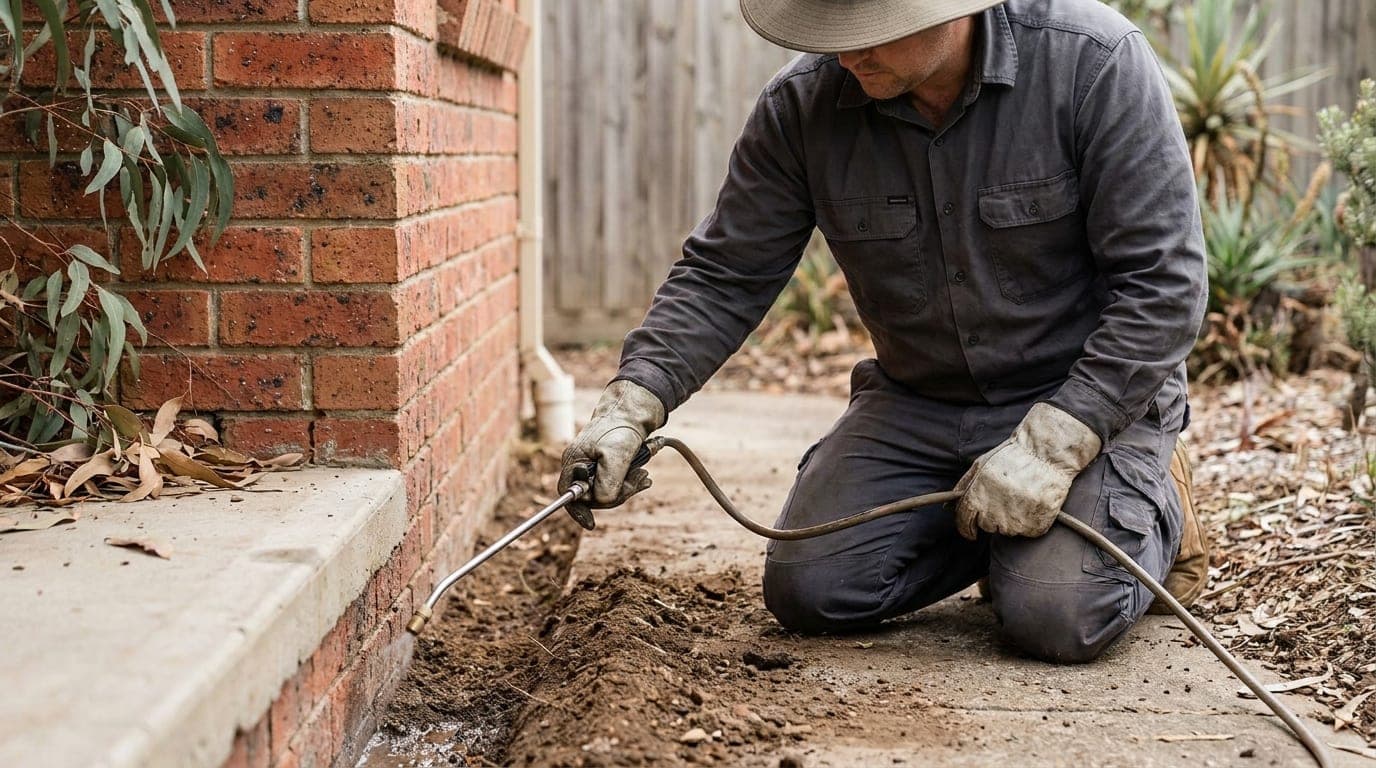
A chemical soil barrier is a continuous band of treated soil installed around and, where possible, underneath the structure. Termites travelling through the soil either die on contact with a repellent-type barrier or, more commonly with modern non-repellent products, pick up the chemical without detecting it and carry it back to the colony, where it spreads through grooming and feeding.
The critical word is continuous. A barrier with a 200mm gap under a garden bed or beside a downpipe isn't a partial barrier, it's a doorway. This is where Adelaide throws up a local problem competitors rarely mention: a large share of Adelaide's older suburban housing stock sits on reactive clay soils that shrink and swell with our dry summers and wet winters. That movement cracks slabs, shifts paving, and opens hairline gaps at expansion joints, exactly the kind of gap a barrier needs to be checked against every year, not just at installation. A barrier installed correctly in 2020 on a home in the western suburbs can have a compromised section by now purely from soil movement, with zero visible signs above ground.
For a full breakdown of what the barrier installation process looks like on-site, see Chemical Soil Barrier Treatment: What to Expect.
Baiting systems: playing the long game
Baiting stations are installed in the soil around the property, spaced to intercept termites already foraging nearby or to lure new activity in. Each station holds a cellulose-based bait laced with an insect growth regulator or metabolic inhibitor, slow enough that termites don't associate illness with the bait and avoid it.
Because termites are social insects that groom and feed each other (trophallaxis), the toxicant spreads through the colony over weeks or months. Done properly, baiting can eliminate the colony itself, not just the individuals visiting your slab. The tradeoff is time and monitoring: stations need regular checks, and a station that sits untouched for months tells you nothing about whether termites are elsewhere on the block.
The full mechanics, station spacing and monitoring schedule are covered in Termite Baiting Systems Explained: Do They Work?
Dusting: for when you've already found the nest
Dusting is different from the other 2 methods because it's reactive, not preventative. A licensed technician applies a fine insecticidal dust directly into an active termite gallery or nest void, usually found during demolition, renovation, or a targeted inspection. Termites crawling through the dust carry it on their bodies back into the colony, and because they groom constantly, it spreads fast among nestmates.
Dusting is rarely a standalone strategy for whole-of-property protection. It's typically paired with a barrier or bait program once the immediate nest has been knocked down, so the property still has ongoing protection against the next colony that tries its luck.
Which method suits your home
The right method depends on 3 things: construction type, soil condition, and whether termites are already active or you're treating preventatively.
- Slab-on-ground homes (common across newer Adelaide developments in the northern and southern suburbs) often need a combination approach, since the slab itself blocks full barrier access and stations fill the gap.
- Homes on stumps or with accessible subfloors are usually more straightforward for a full barrier, since the technician can inspect and treat the whole perimeter and underfloor zone directly.
- Reactive clay soils, which cover much of metropolitan Adelaide, mean barriers need more frequent integrity checks than the same product would need on stable sandy soil elsewhere.
- Active infestations found mid-renovation usually call for dusting first, then a barrier or bait program to prevent recurrence.
This is not a decision to make from a brochure. For a direct side-by-side comparison of the 2 main preventative methods, read Barrier vs Baiting: Which Termite Treatment Is Right for Your Adelaide Home, and if you want a guided answer for your specific property, the termite treatment method selector walks through construction type, soil and budget in a few questions.
What actually happens on treatment day
Whichever method is recommended, the on-site process follows a similar shape: inspection and confirmation of termite activity or risk, identification of access points and soil type, application (trenching and treating soil, drilling through paths or slabs where needed, or installing bait stations at set intervals), and a written report confirming what was done and where.
We connect Adelaide homeowners with licensed, vetted technicians for every stage of this, so the assessment and the treatment are handled by someone qualified to make the call on your specific property, not a generic quote based on square metreage alone. If you want the step-by-step version of treatment day itself, read What Happens During a Termite Treatment (Step by Step).
Why the method matters more than the price
A cheaper quote using the wrong method for your soil or construction type is not a saving, it's a delayed second treatment. Termites cause more structural damage in Australia annually than fire, storm and flood combined according to CSIRO research, and that damage accumulates quietly behind walls while a poorly matched treatment gives a false sense of security. The Australian Government's guidance on termite management standards (AS 3660) sets out the minimum requirements licensed technicians work to, and it's worth asking any operator you're considering whether their proposed method meets it for your specific property.
If you're ready to get a proper assessment rather than a guess, termite treatment connects you with a licensed Adelaide technician who will confirm the right method for your home's construction and soil before any chemical goes in the ground.
The bottom line
Termite treatment isn't one product, it's a method matched to your home. Barriers protect fast and continuously but need soil contact and regular integrity checks, especially on Adelaide's reactive clay. Baiting takes longer but can remove an entire colony. Dusting handles what's already found. Getting the match right the first time is what separates a treatment that works from one that quietly fails behind a wall you can't see.
Ready to get quotes from licensed technicians?
Tell us about your problem and we match you with a vetted local operator. Free, no obligation.
Get free quotesFrequently asked questions
A chemical soil barrier usually shows results within days because it is a continuous zone termites cannot cross undetected. Baiting takes longer, often 2 to 6 months, because it depends on foraging termites finding the bait and sharing it through the colony.
Yes. Many Adelaide properties use a barrier for immediate perimeter protection and baiting stations for colony-level elimination, particularly where a slab or paving prevents full barrier coverage. The licensed technician we match you with will assess whether a combined approach suits your home.
No. Dusting applies a fine insecticidal powder directly onto termites in an active gallery or nest, relying on the termites' grooming and social behaviour to spread it through the colony. Baiting uses food-based bait stations placed in the ground that foragers carry back over weeks.
For most modern barrier and baiting treatments, no. Products used by licensed Australian technicians are applied in ways that keep occupants, kids and pets safe once the area is dry or the stations are secured. Ask the technician you're matched with for specific guidance for your situation.