Moisture, Drainage and Termites: The Connection
Moisture and termites go hand in hand. Learn why poor drainage attracts termites to Adelaide homes and what to fix before it becomes a costly problem.
Key takeaways
- Termites need moisture to survive, so damp subfloors and poor drainage make a home far more attractive to them than a dry one.
- Adelaide's clay-heavy soils in suburbs like Blackwood and the foothills hold water against footings long after rain has stopped.
- Leaking garden taps, blocked downpipes and ag-drains running the wrong way are the most common moisture faults found under Adelaide houses.
- Fixing drainage does not remove an existing termite colony, only inspection and treatment from a licensed technician can confirm and address that.
Moisture and termites are directly linked because subterranean termites, the species responsible for the vast majority of Adelaide's termite damage, cannot survive without a constant source of moisture. Damp subfloors, poorly draining soil and leaking plumbing create the exact conditions termites need to establish and expand a colony close to a home's timber.
Why termites are drawn to moisture in the first place
Subterranean termites live below ground and travel between the soil and a food source (timber) through shelter tubes they build from soil, saliva and their own waste. Those tubes only hold together and remain viable in humid conditions. A dry, well-drained site forces termites to work harder to maintain that humidity, which pushes them toward easier targets. A damp site does the opposite: it hands them a ready-made highway.
This is well documented outside the pest industry too. The CSIRO's guidance on termite biology and building protection notes that moisture control around a structure is one of the most effective non-chemical ways to reduce termite pressure on a building, alongside physical and chemical barriers. It is not a minor detail. It is foundational to how these insects choose where to feed.
Where Adelaide's drainage problems actually start
Adelaide's geography works against homeowners in a few specific ways that are worth understanding rather than glossing over.
Reactive clay in the foothills and southern suburbs
Suburbs such as Blackwood, Belair, Stirling and parts of Mitcham sit on reactive clay soils that swell when wet and shrink when dry. That movement often cracks slab edges and shifts stormwater pipes slightly out of alignment over a decade or two, creating low points where water pools against a footing instead of running away from it. Homeowners in these areas frequently assume a crack is a structural issue only, when it is also a moisture entry point that changes the termite risk profile of the whole perimeter.
Ag-drains that were never checked after installation
Agricultural drains (ag-drains) laid along a foundation during construction are supposed to carry groundwater away from the slab. In practice, on a lot of Adelaide properties built from the 1970s through the 1990s, these drains were laid with insufficient fall, or have since collapsed or silted up. Nobody inspects an ag-drain unless something goes wrong above ground, so a failed drain can quietly saturate the soil against a footing for years. This is one of the more counterintuitive lessons from years of subfloor inspections in this city: the drainage system homeowners assume is protecting them is often the one working against them.
New estates on filled and compacted ground
It is tempting to think newer means safer, but growth corridors like Angle Vale, Blakeview and Mount Barker often sit on fill material compacted before slab pour. Fill does not always drain the way natural, undisturbed soil does, and irrigation systems installed at handover are regularly set to water garden beds hard against the slab edge. The result is a newer home with a moisture problem that an older, better-drained property in a more established suburb may not have.
The everyday moisture sources that matter most
Beyond soil type, most of the moisture problems found during subfloor inspections come down to a short list of avoidable issues:
- Leaking garden taps and irrigation fittings positioned near the foundation line.
- Downpipes disconnected from stormwater, or discharging directly onto the ground beside the house.
- Air conditioning condensate lines draining under the house instead of to a proper outlet.
- Garden beds and mulch banked up against weatherboard or brick veneer, holding moisture against the wall.
- Poor subfloor ventilation that traps humidity rather than letting it escape.
Any one of these, sustained over months, can turn a subfloor from a hostile environment for termites into a comfortable one. For a deeper look at how ventilation specifically affects risk in older Adelaide housing stock, see subfloor ventilation and termite risk in older Adelaide homes.
What to check before it becomes a bigger problem
A practical, non-technical walk-around can catch most of the obvious issues:
- Check under external taps and irrigation valves for damp soil that never seems to dry out.
- Follow every downpipe to its endpoint and confirm it discharges well clear of the foundation.
- Look at garden beds along the house and pull mulch and soil back at least 75mm from weatherholes, weep holes or the top of the slab.
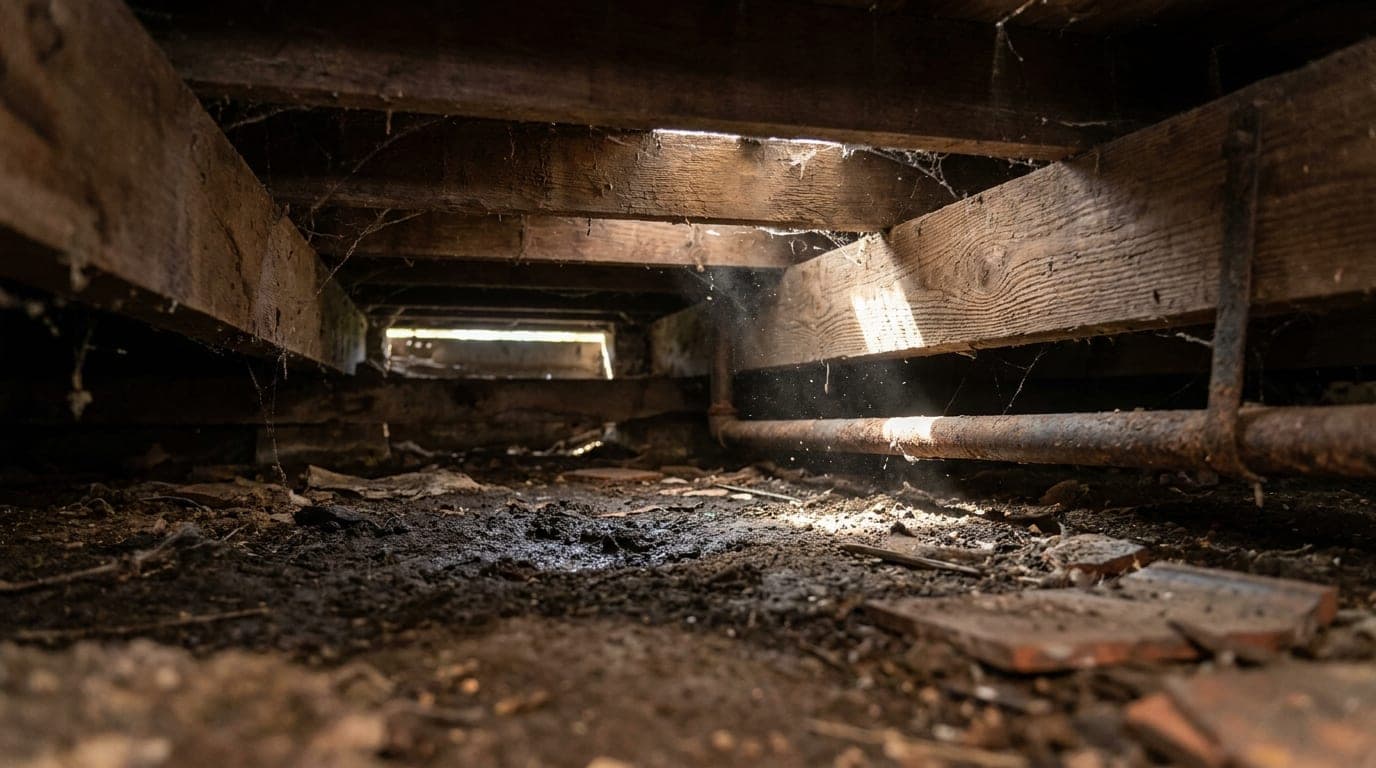
- If there is subfloor access, look (and smell) for dampness, condensation on piers, or a musty odour.
- After heavy rain, walk the perimeter and note anywhere water is pooling rather than draining away within a few hours.
None of this replaces a proper inspection. It is a way to reduce the conditions that make a property attractive to termites in the first place, which sits alongside the broader steps covered in how to prevent termites in your Adelaide home.
Why moisture control is prevention, not treatment
It is worth being direct about the limits of DIY drainage work: fixing a leaking tap or redirecting a downpipe will not remove termites that are already established. If there is existing activity, timber damage, or mud tubes visible on a footing or pier, drainage correction on its own will not resolve it. That requires inspection and, where necessary, treatment by a licensed professional who can identify the extent of activity and apply the right barrier or baiting approach for the property.
This is where we connect you with licensed Adelaide technicians who carry out full termite inspections and can advise on both the moisture issue and any active infestation in the same visit. If a subfloor inspection turns up conditions consistent with termite activity, the licensed technician we match you with can scope termite control options specific to the property, from soil-applied barriers to bait station systems, and outline realistic termite treatment timelines and costs.
The bottom line for Adelaide homeowners
Termites will always go where moisture is easiest to find and timber is easiest to reach. Adelaide's mix of reactive clay, ageing ag-drains and irrigation habits means moisture problems are common even on properties that look well maintained above ground. Addressing drainage is one of the cheapest and most effective things a homeowner can do to reduce risk, but it should sit alongside, not instead of, a proper termite inspection. For guidance specific to a property's soil type, age and construction, Planning SA's building and site information is a useful starting point for understanding local drainage requirements, and a licensed technician can take it from there.
Ready to get quotes from licensed technicians?
Tell us about your problem and we match you with a vetted local operator. Free, no obligation.
Get free quotesFrequently asked questions
No. Improving drainage removes one of the conditions termites rely on, but it will not remove an existing colony or nest. If termites are already active, the licensed technician we match you with needs to inspect and treat the property directly. Drainage work is prevention, not treatment.
As a general guide, subfloor timber and soil should feel dry to the touch, not damp or cool. Visible condensation on subfloor piers, a musty smell, or moisture readings above 20 percent in timber (measured with a moisture meter) are signs the subfloor is wetter than it should be and worth having assessed.
Age helps but does not remove the risk. New estates in areas like Angle Vale and Blakeview are often built on reactive clay with compacted fill, and irrigation systems installed at handover are a common source of ongoing dampness against slab edges. Newer homes still need the same drainage discipline as older ones.
Mulch itself is not the direct cause, but deep mulch banked against a wall holds moisture against the foundation and can bridge the gap inspectors rely on to see termite activity before it reaches timber. Keeping mulch pulled back from the wall line is a simple, low-cost precaution.