Termite Prevention and Protection for Adelaide Homes
Termite prevention adelaide starts with moisture control, subfloor airflow and a chemical barrier. Here is what actually stops termites reaching Adelaide homes.
Key takeaways
- Termite prevention adelaide is about removing moisture and timber contact points, not just applying a chemical after the fact
- Adelaide's reactive clay soils crack in summer and open pathways termites use to reach subfloors undetected
- A chemical soil barrier plus a physical inspection routine outperforms either measure used alone
- Annual checks catch damage while it is still cheap to fix, long before a swarm forces an expensive call
- Adelaide Hills homes with retained bushland nearby carry meaningfully higher pressure than suburban blocks
The short answer
Termite prevention in Adelaide means closing off the 3 things termites need: moisture, timber contact, and an undetected path into the subfloor. That combination of a licensed chemical soil barrier, moisture management around the foundation, and an annual inspection is the accepted standard, not any single treatment on its own. Skip one piece and you have not actually prevented anything, you have just delayed the discovery.
Adelaide sits in a termite-active zone across most of its metropolitan and hills suburbs, and the risk is not evenly spread. Reactive clay soils, ageing subfloor timber stock, and drought-then-deluge weather cycles all raise pressure on established homes. If your property backs onto a reserve, has established gums nearby, or sits in the Adelaide Hills, you are dealing with meaningfully more termite activity than a new-build on a flat coastal block. Understanding why matters more here than in most cities, because it changes how aggressive your prevention needs to be.
Why Adelaide's soil and climate work against you
Most Adelaide homeowners assume termites are a "some suburbs" problem. They are closer to a "most suburbs, different intensity" problem. The reactive clay soils common across the Adelaide Plains expand when wet and contract hard in summer, opening fine cracks that run straight down to subfloor level. Termites exploit exactly this kind of gap because it lets them travel underground, avoiding surface exposure and detection, right up to a bearer or stump.
This is the counterintuitive part most homeowners get wrong: they assume a dry Adelaide summer is a low-risk period. In practice, the crack-then-swell cycle from a hot, dry summer followed by autumn rain is when subterranean colonies push hardest for new moisture sources, and a home's subfloor becomes one of the most attractive targets around. Older Adelaide housing stock, particularly solid brick homes from the 1950s to 1970s with timber subfloors, sits right in that risk window because the original construction rarely accounted for it.
If you want the suburb-by-suburb picture in more depth, our breakdown of which Adelaide suburbs and home types carry the most risk covers the soil types and housing eras that matter most. Adelaide Hills properties face an additional layer again, driven by retained bushland and higher rainfall.
Moisture control is the cheapest prevention you have
Every termite prevention conversation eventually comes back to moisture, and for good reason. Termites need it to survive, and an Adelaide home almost always supplies it somewhere: a dripping tap under the house, a downpipe discharging against a footing, or a subfloor vent blocked by paving laid during a renovation.
Fixing these costs nothing beyond noticing them. Walk your subfloor perimeter twice a year and check for:
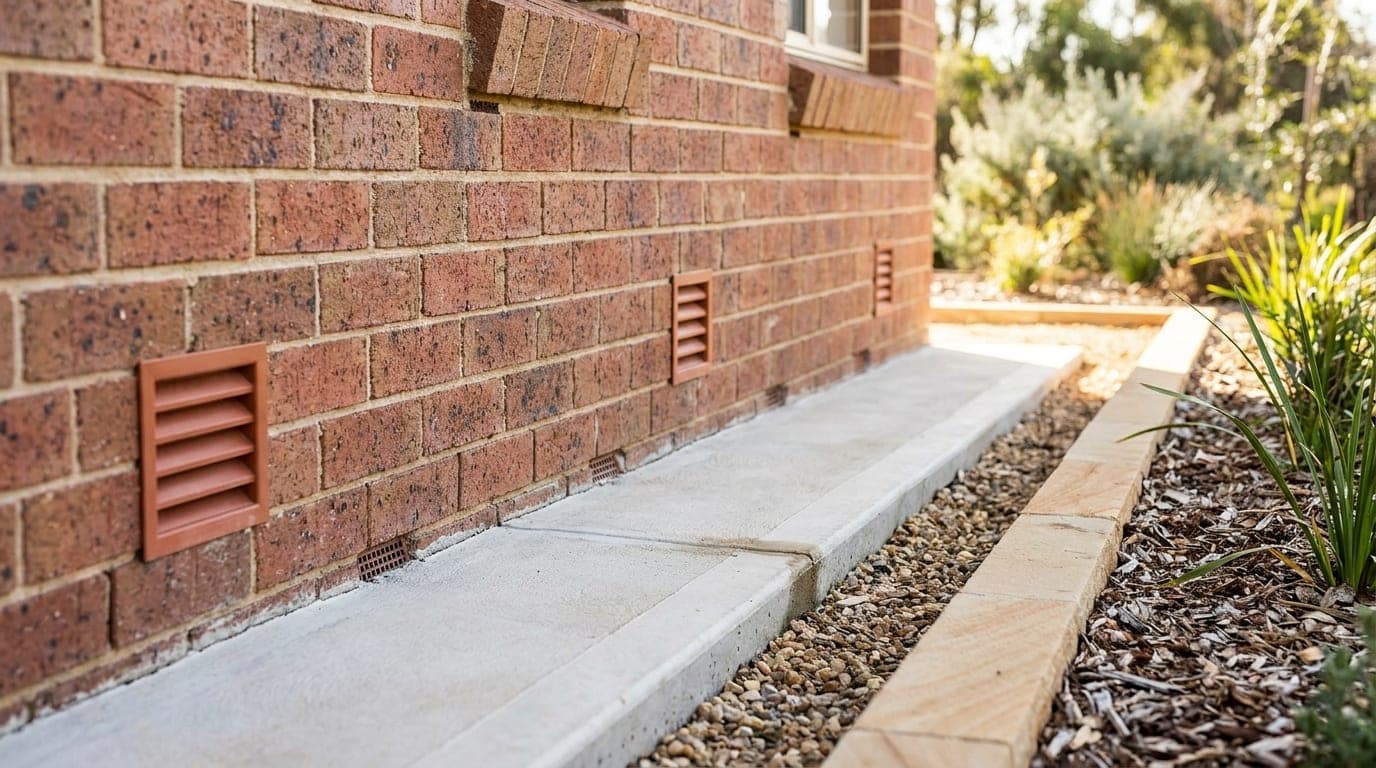
- Blocked or painted-over subfloor vents (airflow keeps timber dry and termites dislike ventilated spaces)
- Garden beds or retaining walls built up against weatherboard or brick cladding
- Downpipes and air-conditioner condensate lines draining straight against the foundation
- Leaking taps, hoses, or irrigation lines running near the house
The connection between moisture and termite activity is detailed further in our piece on moisture, drainage and termites, and for homes with restricted underfloor airflow specifically, see subfloor ventilation and termite risk in older Adelaide homes.
Landscaping mistakes that undo good prevention
Adelaide's gardening habits work against termite prevention more often than people realise. Mulch piled against a foundation wall, timber garden edging in direct soil contact, or stacked firewood left touching the house are all invitations, not just cosmetic choices. Termites will use any of these as a bridge that skips the chemical barrier entirely, because the barrier only protects the soil it was applied to, not the timber sitting on top of mulch six centimetres above it.
This is one of the most common and most avoidable mistakes we see across Adelaide properties, and it is covered in full in landscaping and mulch mistakes that attract termites. If you are landscaping around a home that already has a barrier installed, treat the barrier depth as a hard boundary, not a suggestion.
The chemical barrier: your baseline, not your whole plan
A properly installed chemical soil barrier remains the backbone of termite prevention for established Adelaide homes, and it is what most licensed technicians will recommend as the starting point. It creates a treated zone around the foundation that termites cannot cross undetected, forcing them into the open where they die or are deterred.
The mistake homeowners make is treating the barrier as a one-off fix rather than a system with a lifespan. Chemical barriers degrade over years, and any soil disturbance (a new garden bed, a trench dug for plumbing, a fence post reset) can breach the treated zone without anyone realising. That is precisely why the barrier needs to sit alongside inspections, not instead of them. If your home already has an ageing barrier and you are unsure of its condition, termite barriers and how long they last explains what shortens or extends that lifespan.
For homes still under construction or undergoing major extensions, South Australian building regulations set specific requirements for termite management systems, which we cover in new build termite protection: what SA regulations require.
Annual inspections catch what prevention alone cannot
Even a well-maintained barrier and a dry subfloor will not stop every termite incursion. What changes the outcome is catching activity in its first year rather than its fourth, when the difference is a repair bill in the hundreds rather than a structural one running into thousands. An annual inspection by a licensed technician checks for mud tubes, damaged skirting, and moisture readings in timber that a homeowner walking through casually will miss.
We set out the case for this cadence, including why 6-monthly checks make sense for higher-risk properties, in annual termite checks: why once a year matters. It is worth pairing that with a general audit of habits, since 10 termite mistakes Adelaide homeowners make covers the recurring errors an inspection routine is specifically designed to catch before they compound.
What effective prevention looks like in practice
Put together, a defensible termite prevention plan for an Adelaide home includes a chemical soil barrier appropriate to your construction type, subfloor moisture and ventilation maintained year-round, garden and mulch clearances respected around the entire perimeter, and an inspection booked annually (or twice yearly in higher-pressure locations). None of these steps is optional if you want the others to actually work. A pristine chemical barrier undone by a blocked subfloor vent is still a home at risk, and a dry subfloor with no barrier is still exposed to a colony that finds the one crack in the clay.
The Commonwealth Scientific and Industrial Research Organisation (CSIRO) has published guidance confirming that integrated management, not single-method treatment, is the standard approach for subterranean termite species common across southern Australia, which reflects exactly this layered approach.
If you want a technician to assess your specific risk factors and put a prevention plan in place, we connect you with licensed Adelaide technicians through our termite control service, matched to your suburb, soil type, and construction era rather than a generic checklist.
Getting started
Termite prevention in Adelaide is not a single purchase, it is an ongoing routine built around your home's specific exposure: its soil, its age, its garden, and its location relative to bushland or reserves. Start with the moisture and landscaping fixes this week, since they cost nothing and remove the easiest pathways termites exploit. Then get a licensed assessment of your barrier status and inspection schedule, because that is the part a homeowner cannot safely judge alone. The technician we match you with can tell you within one visit whether your current setup is actually doing its job or just looks like it is.
Ready to get quotes from licensed technicians?
Tell us about your problem and we match you with a vetted local operator. Free, no obligation.
Get free quotesFrequently asked questions
Combine a professional chemical soil barrier around the foundation with moisture control (fixed leaks, cleared subfloor vents, no mulch against timber) and an annual inspection. No single measure catches everything a home in Adelaide's clay soil regions is exposed to.
You can remove risk factors yourself: clear mulch from foundations, fix leaking taps and downpipes, and keep subfloor vents open. But a compliant chemical barrier and a trained inspection for early activity need a licensed technician, which is why DIY alone is not considered adequate prevention under Australian Standard AS 3660.
At least once a year, and every 6 months for homes in the Adelaide Hills or near reserves, drainage lines, or established gum trees, since these locations carry consistently higher termite pressure.
No barrier is permanent. Chemical soil barriers typically last 5 to 8 years depending on the product and soil disturbance, and physical/reticulation systems need periodic recharging. Ongoing inspection is what makes any barrier effective long-term.