New Build Termite Protection: What SA Regulations Require
New build termite protection in SA means a chemical or physical barrier under the National Construction Code. Here is what is compulsory and what is optional.
Key takeaways
- The National Construction Code requires a termite management system on every new home built in South Australia, not just an optional extra.
- A durable chemical barrier or physical barrier satisfies the code, but neither stops termites from reaching untreated timber elsewhere on the block.
- New builds on reactive clay, common across the Adelaide Plains and foothills, need barrier continuity checked at every slab penetration and services trench.
- The compliance sticker in the meter box only proves a system was installed, not that it is still intact after landscaping or renovations.
New build termite protection in South Australia is not optional: the National Construction Code requires every new Class 1 home to have a termite management system installed at construction, either a chemical soil barrier, a physical barrier, or a reticulation system, with a durability statement and compliance sticker handed over at completion.
Why this is a code requirement, not a builder upsell
Termite management on new construction sits inside the National Construction Code (NCC), administered nationally and enforced in South Australia through the Building Code of Australia provisions that private certifiers check off before occupancy. It is treated the same way as waterproofing or structural footings: a mandatory system, not a line item you can decline. The Australian Building Codes Board publishes the current NCC requirements for termite risk management (Volume 2, Part 3.1.3), and every builder in SA works to that standard regardless of block size or budget.
What this means practically: your new build already has a termite management system in it somewhere. The real question for homeowners is not "do I need one" but "which type did I get, where does it cover, and what happens as the house ages." That is where most new-build owners in Adelaide get caught out, because the compliance sticker in the meter box tells you a system exists, not what it is or how long it lasts.
The three systems builders actually install
Chemical soil barriers
A continuous zone of termiticide-treated soil is created around and under the slab before pouring. This is the most common system on project homes across growth corridors like Mount Barker, Angle Vale, and Blakeview, because it is fast to install during the slab stage and cheap at scale. Products vary in expected working life, most sit somewhere between 8 and 10 years, and the durability statement in your handover pack should specify which product was used. For a detailed look at how this works, see Chemical Soil Barrier Treatment: What to Expect.
Physical barriers
Graded stone particles or termite-resistant membranes physically block termites from passing through gaps too small for them to move around but too large for them to tunnel through. These are common under slab penetrations and around plumbing penetrations even where a chemical barrier is the primary system, because pipes and conduits create the gaps a soil barrier alone cannot seal.
Reticulation systems
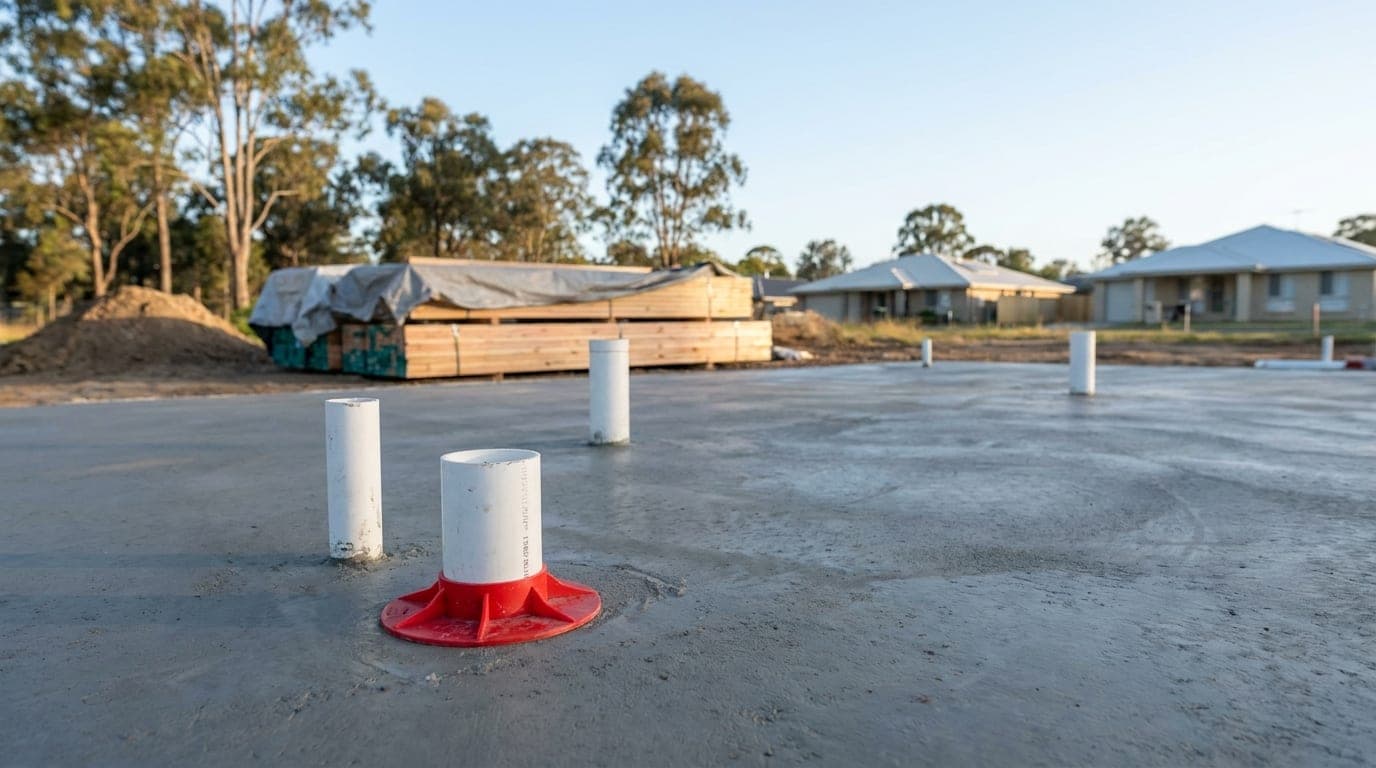
A network of pipes is cast into the slab edge or subfloor during construction, capped and left ready for a technician to inject fresh chemical when the original barrier is due for renewal, without digging up paving or garden beds. It is the system worth understanding in more depth if your build has one, covered fully in Termite Reticulation Systems: Built-In Protection for New Builds.
Where new builds in Adelaide actually fail
Here is the part builders rarely spell out: the code requires the barrier to be continuous, and continuity is the single most common point of failure on new Adelaide builds, not the barrier product itself. Every slab penetration, every stormwater and sewer trench, every garden bed built up against the slab edge after handover is a potential gap. On reactive clay soils, which cover large parts of the Adelaide Plains and much of the northern and southern growth corridors, slight ground movement in the first few years after construction can open hairline gaps around service penetrations that were sealed at handover. I have seen this specifically on volume-builder homes where the plumber's trench for the kitchen and laundry wet areas was backfilled after the barrier inspection had already been signed off, which is a timing issue more than a materials issue.
The second common failure is landscaping. New owners pour a mountain of enthusiasm (and mulch) into their first garden within 12 months of moving in, and garden beds built up over the weep holes or against the slab edge bridge the barrier entirely, giving termites a concealed path straight to the frame. This is covered in detail in Landscaping and Mulch Mistakes That Attract Termites, but the short version for new builds: keep garden beds and mulch at least 75mm below the top of the slab, and never let weep holes get covered.
What the compliance sticker does and does not tell you
The sticker fixed inside your meter box (required under the NCC) records the system type and installation date. It is proof of installation, not an ongoing warranty, and it will not tell you if the barrier has since been breached by trench work, an extension, or a deck footing. Read the durability statement in your handover file closely: it will state the expected effective life of the chemical used, and that clock started on the day of installation, not the day you moved in or the day you first thought about it.
Because reactive clay and the pace of new estate development across Adelaide's outer suburbs both work against barrier integrity over time, we recommend treating a new build the same way as an annual termite check on an established home, starting from around year 3 to 4 rather than waiting for the original barrier's full expected life to run out. It is a small, early habit that avoids a much larger structural conversation a decade in.
Getting your new build assessed properly
If you cannot locate your durability statement, or you have had trench work, a deck, or landscaping done since handover and want the barrier's continuity checked, that is a job for a licensed inspection, not a guess based on the meter box sticker. We connect you with licensed Adelaide technicians through our termite control network who can identify what system is already protecting your slab, confirm whether it is still intact, and advise on the right renewal timing, whether that means reticulation top-ups, a fresh chemical barrier, or targeted repairs where the original system has been compromised. For homes further along in their protection lifecycle, our guide to chemical barrier treatment covers what a full renewal involves and when it typically becomes necessary.
Ready to get quotes from licensed technicians?
Tell us about your problem and we match you with a vetted local operator. Free, no obligation.
Get free quotesFrequently asked questions
Yes. The National Construction Code requires a termite management system on new Class 1 and Class 10 buildings, and SA certifiers will not sign off occupancy without evidence of an installed system, typically a durability statement and a compliance sticker in the meter box.
Builders generally choose either a chemical soil barrier applied under and around the slab, a physical barrier such as graded stone or a termite-resistant membrane, or a reticulation system with a network of pipes for future chemical top-ups. The licensed technician we match you with can explain which system is already in your home and how it should be maintained.
No. It protects the areas where the barrier was installed at construction, and chemical barriers break down over time (commonly 8 to 10 years). Landscaping, deck additions, and services work after handover can also breach the barrier, so ongoing annual checks matter even in a new home.
Ask your builder or check your handover documents for a Certificate of Construction Compliance and a durability statement, which lists the product used and its expected working life. If you cannot find this paperwork, a licensed technician can inspect the slab perimeter and subfloor for physical evidence of the barrier type.